The One Wiki to Rule Them All


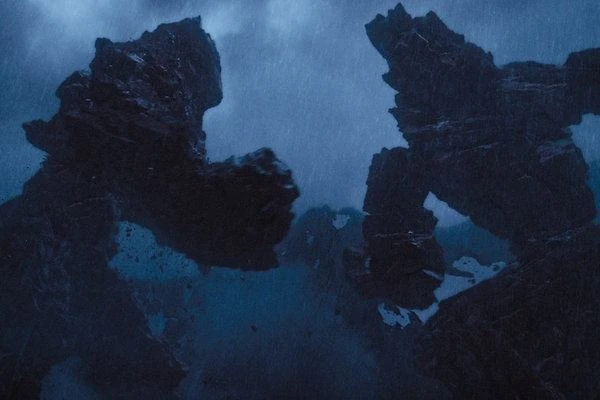
"When he peeped out in the lightning-flashes, he saw that across the valley the stone-giants were out, and were hurling rocks at one another for a game, and catching them, and tossing them down into the darkness where they smashed among the trees far below, or splintered into little bits with a bang."
From "Over Hill and Under Hill"[2]

Giants were a mysterious and seldom-mentioned race of Men[6] living primarily in the mountains of Middle-earth.[2]

History[]

The exact origins of Giants are untold, as is when exactly they first appeared in Middle-earth; however, it seems that they were, like Hobbits, a race of Men.[6] During the late First Age, Lúthien invoked the neck[7][8] of Gilim,[9] a giant associated with Araman[10] and winter,[11] and the sword of Nan,[9] an elm-like giant associated with the South and summer,[12] in her lengthening spell[9] to escape Hírilorn.[13]

In a part of the Lay of Eärendil[14],[15] Wade of the Helsings was a giant associated with Tuor.[16] In the late First Age, Eärendil set sail in Vingilot and had many voyages in his quest to reach Valinor. During one of these voyages, Vingilot was driven south by the wind into dark regions and fire-mountains where he encountered Tree-men giants alongside Sun-dwellers, pygmies, and Sarqindi.[1]

Giants are mainly beings of legend. One such local legend among the indigenous people of Lamedon or Erech spoke of a group of Giants that once lived "in ancient days" in the region between the White Mountains and Belegaer, north of the Bay of Belfalas. According to the legend, these Giants raised the White Mountains in order to prevent Men from entering their land close by the Sea. One of them, Tarlang, stumbled and fatally broke his neck while "carrying a heavy load of rocks". Due to his size, his fellow Giants did not clean up his body and instead incorporated his corpse into their wall. This etiological myth was used to explain the names of some locations in Gondor: Cûl Veleg and Cûl Bîn were his load of rocks, Dol Tarlang was his head, the rocky massif in front of the latter was the rest of his body, while Tarlang's Neck was where his neck had broken.[4]

A Giant, by the White Council

A Giant, by the White Council

The city of Minas Tirith seemed to have been "carved" by Giants out of the rock on Amon Tirith.[17] The Ettenmoors owed their name to some gigantic creatures of that land,[18] although these were perhaps merely some kind of trolls.[19] Gandalf was known for telling great stories about Giants at parties,[20] and Bilbo Baggins had heard many "horrible names of" Giants and Ogres in tales.[21] Some say that Beorn is a bear descended from the great and ancient bears of the mountains that lived there before the Giants came, though Gandalf found this story less likely to be true.[5] At one point, Bilbo saw a rock in a stream, and wondered if it had been cast miles into the plain by some giant among giants.[5] He also compared being struck like the crash of battering-rams made of forest oaks and swung by giants.[citation needed]

The stone-giants lived in the Misty Mountains during the late Third Age where great bears lived there before their arrival.[5] They found sport in throwing rocks at each another, and then into the depths below to hear them shatter "among the trees", during a violent thunderstorm.[2] Their physical form was not described, nor was much else about them. Presumably, not all Giants were savage or evil, as Gandalf hoped to convince "a more or less decent" Giant to block the Front Porch to Goblin-town to make the High Pass in the Misty Mountains safe again.[22]

On April 12 of TA 3018, Samwise Gamgee told Ted Sandyman in the Green Dragon Inn about rumors regarding sightings of Tree-men giants beyond the North Moors. When Ted questioned Sam's credibility, Sam stated that his cousin Halfast Gamgee actually saw one of these giants which apparently "was as big as an elm tree, and walking - walking seven yards to a stride". Ted still questioned the credibility of the rumor.[3]

Etymology[]

Norsa was a Quenya name meaning "a giant", derived from the root NOROTH.[23] Noroth was a Noldorin name[24] meaning "giant" that is also derived from NOROTH.[23] A discarded Quenya word was hanako was an early Quenya name meaning "giant" that is derived from the root KHAN-AK'.[25]

Background[]

Some fans and scholars assume that giants are a fleeting idea of Tolkien's while writing The Hobbit that was never considered again for incorporation into the developing legendarium. John D. Rateliff has argued that they might have become "free agents"; not wicked, but simply not aware of their surroundings.[26] Robert Foster comments that the stone-giants "may be no more serious than Golfimbul".[27]

Other theories attempt to include the Giants among the known races of Arda. For example, they might be a large race of Men (like Hobbits are a small race of Men), Trolls, or simply "nature spirits" more or less like Tom Bombadil.[28] Furthermore, Douglas A. Anderson's annotations in The Annotated Hobbit express the opinion that stone-giants are a variety of Troll.[29]

In other versions[]

In an early manuscript, the Giants are counted among the Úvanimor, servants of Melko.[30] In another manuscript, the Giants are counted among the Earthlings, and are divided between the "wood-giants" (Qenya ulbandi) and the "mountainous-giants" (Qenya taulir).[31]

In the second draft of The Hobbit, Bladorthin, the predecessor of Gandalf, is said to have "rescued so many princesses, earls, dukes, widow’s sons and fair maidens from unlamented giants"[32] instead of simply telling great stories of them.[33]

Giants portrayed in The Hobbit films

Giants portrayed in The Hobbit films

Giants were the wicked precursors of Ents. The elm-like features of Nan, and that in early versions of The Lord of the Rings it was the Giant, Treebeard, who held Gandalf captive, not Saruman,[34] makes the connection between Giants and Ents within J.R.R. Tolkien's imagination clear.[26]

An early name for the Ettenmoors was called "Entish Lands". As Christopher Tolkien notes, "Ent" comes from an Old English word for "giant",[35] and was used before Tolkien conceived the later benevolent Ents of The Two Towers.[36] The word is seen at various points in Beowulf, for example line 2717, enta geweorc, "the work of Giants".[37]

In a draft for what would become the chapter The Shadow of the Past from The Fellowship of the Ring, it is mentioned that the Necromancer was rallying his forces and causing wars and devastation from his stronghold in Mordor, and that Giants were said to be among those forces.[6]

Inspiration[]

In a version of the lay of Eärendel, Tolkien's use of the name Wade of the Helsings may have been inspired by the sea-giant of legend.[16] Christopher Tolkien and John Rateliff speculate that some of the various references to giants by J.R.R. Tolkien are inspired by giants from various mythology, such as fire-giants,[26] frost-giants,[26] hill-giants,[38] sea-giants, and storm-giants.[38]

In Germanic mythology names for the Giants were jotun (Norse) and eoten (Old English), creatures similar to each other in strength and bestial nature. From the latter word eoten, Tolkien derived the name "etten".[38][36]

Wayne G. Hammond and Christina Scull have suggested that the statement in The Return of the King that Minas Tirith "seemed to have been"[17] carved by Giants out of the rock on Amon Tirith derives from Old English mythology, in which Giants were often portrayed as builders of ancient structures.[39]

In other writings[]

In the poem, The Prophecy of the Sibyl, which Tolkien probably wrote in the 1930s, a character called "the Giant of old" is prophesied to come from the East.[40] In Farmer Giles of Ham, Giants are described as rude and uncultured folk, and troublesome at times, and being as large as elms and stupid.[41] One particular Giant troubles Farmer Giles' land, who chases him off with his blunderbuss.[41] In Tolkien's fragmentary sequel to Farmer Giles of Ham, a Giant named Caurus Maximus (Latin for "big giant") holds the son of Giles hostage for a time.[42] In a rejected portion of the Foreword to The End of Bovadium[43], Dr. Gums mentions that "a race of giants" that once inhabited "the prehistoric remains in this island" were often employed to excavate "vast pits and tunnels for no ascertainable purpose" and to transport "large quantities of stone to inaccessible regions", according to "popular tradition".[44] There may be a loose connection between these Giants and references to generic fairy tale Giants mentioned in The Hobbit tales.

In adaptations[]

Middle-earth Role Playing[]

In the 1982 Middle-earth Role Playing game, several divisions and races of giants are described and given statistics, such as Stone Giants,[45] Ice Giants,[46] Giants of the Southern Misty Mountains,[47] and Red Giants.[48]

The Hobbit: Book One[]

In Book One of the three-part 1989 comic adaptation, the stone-giants are displayed as bearded gigantic Men with regular leather attire.

Middle-earth Collectible Card Game[]

In the 1995 Middle-earth Collectible Card Game, Giants, called Thunder's Companions, are one of the Hazard Creatures.

The Hobbit: The Prelude to The Lord of the Rings[]

In the 2003 video game, The Hobbit: The Prelude to The Lord of the Rings, stone-giants are humanoid golem-like creatures made of stone that appear in the fourth level, hurling rocks at Bilbo as he tries to travel along a mountain-path. They are completely made of stone, and their stones are dangerous.[49]

The Lord of the Rings: The Battle for Middle-earth II[]

A Mountain Giant in BFME II

A Mountain Giant in BFME II

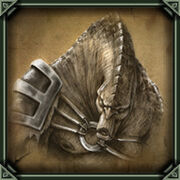
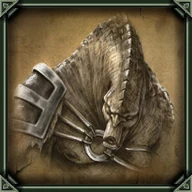
In the 2006 video game, The Lord of the Rings: The Battle for Middle-earth II, Mountain Giants are large and powerful beings appearing as members of the Goblin faction, with brown scaly skin. They seem to have a reddish tinge to them and can hurl stones at great distance. They throw the largest boulders in the game, being the ultimate Goblin long-range artillery units. Though normally content in their dangerous pursuits (though only dangerous to non-Mountain Giants) and often neutral towards other species, a few had an unusual alliance with Gorkil, the Goblin King, who promised them more interesting 'targets' for the boulders which they hurled.

In the DLC expansion, The Lord of the Rings: The Battle for Middle-earth II: The Rise of the Witch-king, the Witch-king convinces other Mountain Giants to fight for them, possibly suggested or arranged for by Rogash. These can be summoned by Thrall Masters in specific missions and by their respective Tier 3 power, which calls two Mountain Giants.

The Lord of the Rings Online[]

In the 2007 video game, The Lord of the Rings Online, there are several different tribes of giants. Two tribes live in the Misty Mountains - the most human-like race lives in the Misty Mountains and one can be found in the High Moor between Rivendell and Eregion. The other is found north-west of Bree in the woods. Stone-giants and Ice-giants appear in Misty Mountains (in one fellowship instance). Finally, there are the Jorthkyn, who are in the North Downs, Lone-lands, and the edge of Angmar. While some are enemy creatures, others remain neutral and can be befriended by the player.

The Lord of the Rings: War in the North[]

In the 2011 video game, The Lord of the Rings: War in the North, it is said that they aren't aggressive towards the inhabitants of Middle-earth, with the exception of Bargrisar, a renegade Stone-Giant who serves as a boss character. Swayed by Sauron and corrupted by Agandaûr, he becomes the leader of a large party of Orcs and Trolls. Backed by his army, Bargrisar seeks to destroy the nests of the Great Eagles and plunder the North for riches. Similar to the portrayal in Peter Jackson's The Hobbit: An Unexpected Journey, Bargrisar is a being composed entirely of stone.

The Hobbit: An Unexpected Journey[]

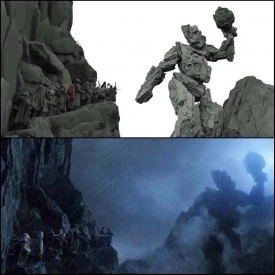
A stone giant, before and after visual effects in

A stone giant, before and after visual effects in The Hobbit: An Unexpected Journey

Stone-giants appear in Peter Jackson's The Hobbit: An Unexpected Journey in 2012. They were interpreted as literally being colossal stone entities, appearing as hewn from stone, and as the size of mountains - indistinguishable from a cliff-face when still. This is somewhat reminiscent of the more tree-like design of the Ents in the previous trilogy, with the giants appearing more inspired by nature than by humanoid appearance. The stone-giants are seen fighting each other and throwing rocks as Thorin and Company travel over the Misty Mountains.
LEGO The Hobbit: The Video Game[]

In LEGO The Hobbit: The Video Game (2014), multiple stone-giants appear as the main conflict in the level Over Hill and Under Hill, in which their fighting poses a threat to the party.

The Lord of the Rings: The Rings of Power[]

In the fourth episode of The Lord of the Rings: The Rings of Power's first season, Galadriel tells Elendil of the stone-giants of the North Moors.[50] While stone-giants are never said to dwell there in the books, it is possible that this is a subtle allusion to the "Tree-men", the only giants mentioned in the books to dwell in that area.[3]

Gallery[]

Translations[]

Foreign Language Translated name
Azerbaijani Nəhənglər
Arabic العمالقة
Armenian Գիգանտներ
Basque Erraldoiak
Belarusian Cyrillic Волаты
Bulgarian Cyrillic Великаните
Catalan Gegants
Croatian Divove
Czech Obři
Danish Stenkæmper
Dutch Reuzen
Esperanto Gigantoj
Finnish Jättiläiset
French Géants
Galician Xigantes
German Steinriesen
Greeks Γίγαντες
Hungarian Óriások
Indonesian Raksasa-raksasa
Italian Giganti
Korean 거인
Latin Gigantes
Latvian Milži
Lithuanian Milžinai
Luxembourgish Rise
Macedonian Cyrillic Џинот
Norwegian Giganter
Persian غول‌های
Polish Kamienne Olbrzymy
Portuguese Gigantes
Romanian Giganții
Russian Великаны
Serbian Џинови (Cyrillic) Džinovi (Latin)
Spanish Gigante de piedra
Tajik Cyrillic На́ьрташ
Turkish Devler
Ukrainian Cyrillic Велетні
Vietnamese Những gã khổng lồ
Welsh Cawres


References[]

  1. 1.0 1.1 The History of Middle-earth, Vol. II: The Book of Lost Tales Part Two, V: "The Tale of Eärendel", pgs. 254, 261
  2. 2.0 2.1 2.2 2.3 The Hobbit, ch. IV: "Over Hill and Under Hill"
  3. 3.0 3.1 3.2 The Lord of the Rings, The Fellowship of the Ring, Book One, Ch. II: "The Shadow of the Past", pgs. 58-9
  4. 4.0 4.1 The Lord of the Rings: A Reader's Companion, "Nomenclature of The Lord of the Rings", pgs. 536-7
  5. 5.0 5.1 5.2 5.3 The Hobbit, ch. VII: "Queer Lodgings"
  6. 6.0 6.1 6.2 The History of Middle-earth, Vol. VI: The Return of the Shadow, The Second Phase, XV: "Ancient History", pg. 253
  7. The History of Middle-earth, Vol. II: The Book of Lost Tales Part Two, I: "The Tale of Tinúviel", The Tale of Tinúviel, pg. 19 ("19")
  8. The History of Middle-earth, Vol. II: The Book of Lost Tales Part Two, I: "The Tale of Tinúviel", The second version of the Tale of Tinúviel, pg. 46
  9. 9.0 9.1 9.2 The History of Middle-earth, Vol. III: The Lays of Beleriand, III: The Lay of Leithian, "Canto V (Lúthien's captivity in Doriath)", pg. 205 (lines 1496-7)
  10. The History of Middle-earth, vol. X: Morgoth's Ring, Part Three: "The Later Quenta Silmarillion": (II) The Second Phase, Of the Thieves' Quarrel, pg. 295 (§14)
  11. The History of Middle-earth, Vol. I: The Book of Lost Tales Part One, "Appendix: Names in the Lost Tales - Part I", pg. 260 (entry "Melko")
  12. The History of Middle-earth, Vol. II: The Book of Lost Tales Part Two, I: "The Tale of Tinúviel", "Notes and Commentary", (iii) Tinúviel’s ‘lengthening spell’, pgs. 67-8
  13. The Silmarillion, "Of Beren and Lúthien"
  14. The Silmarillion, ch. 24: "Of the Voyage of Eärendil and the War of Wrath"
  15. The Silmarillion, "Akallabêth: The Downfall of Númenor"
  16. 16.0 16.1 The History of Middle-earth, Vol. III: The Lays of Beleriand, II: Poems Early Abandoned, (ii): "Fragment of an alliterative Lay of Eärendel", pgs. 142-4 (lines 7-8)
  17. 17.0 17.1 The Lord of the Rings, vol. III: The Return of the King, Book Five, ch. I: "Minas Tirith", pg. 23
  18. The Lord of the Rings, vol. I: The Fellowship of the Ring, Book One, ch. 12: "Flight to the Ford"
  19. The Lord of the Rings: A Reader's Companion, pg. 183
  20. The Hobbit, ch. I: "An Unexpected Party"
  21. The Hobbit, ch. V: "Riddles in the Dark"
  22. The Hobbit, ch. VI: "Out of the Frying-Pan into the Fire"
  23. 23.0 23.1 The History of Middle-earth, Vol. V: The Lost Road and Other Writings, Part Three: "The Etymologies", cf. the root NOROTH
  24. Roman Rausch, "Essekenta Endamarwa - Names from The Return of the Shadow, The Treason of Isengard and The War of the Ring" on Sindanórie, December 23, 2006
  25. Vinyar Tengwar 45, "Addenda and Corrigenda to the Etymologies — Part One", pg. 21
  26. 26.0 26.1 26.2 26.3 The History of The Hobbit: Mr Baggins and Return to Bag-End, The Second Phase, IV: "Goblins", (iii): "The Giants", pgs. 143-5
  27. The Complete Guide to Middle-earth: The Definitive Guide to the World of J.R.R. Tolkien, pg. 366
  28. Steuard Jensen, "What were the giants?" on "Tolkien Meta-FAQ"
  29. The Annotated Hobbit: Revised and Expanded Edition, pg. 104
  30. The History of Middle-earth, Vol. I: The Book of Lost Tales Part One, X: "Gilfanon's Tale: The Travail of the Noldoli and the Coming of Mankind", pg. 75
  31. Parma Eldalamberon, issue XIV: Early Qenya and Valmaric, pg. 9
  32. The History of The Hobbit: Mr Baggins and Return to Bag-End, The First Phase, I(b): "The Bladorthin Typescript", pg. 24
  33. The History of The Hobbit: Mr Baggins and Return to Bag-End, The First Phase, I(b): "The Bladorthin Typescript", ii: "Bladorthin", pg. 31
  34. The History of Middle-earth, Vol. VI: The Return of the Shadow, The Third Phase, (3), XXI: "To Weathertop and Rivendell"
  35. The History of Middle-earth, Vol. VI: The Return of the Shadow, The First Phase, XI: "From Weathertop to the Ford", "Note on the Entish Lands"
  36. 36.0 36.1 The History of Middle-earth, Vol. VII: The Treason of Isengard, III: The Fourth Phase, (2): "From Bree to the Ford of Rivendell", pg. 65 (note 32)
  37. Howell D. Chickering, Jr., "Beowulf: A Dual Language Edition", pgs. 212-3
  38. 38.0 38.1 38.2 The History of Middle-earth, Vol. VII: The Treason of Isengard, XV: "The First Map of The Lord of the Rings", pg. 306
  39. Christina Scull and Wayne G. Hammond, The Lord of the Rings: A Reader's Companion, pg. 514
  40. J.R.R. Tolkien; Christopher Tolkien (eds.), The Legend of Sigurd and Gudrún, Appendix B: "The Prophecy of the Sibyl"
  41. 41.0 41.1 Tales from the Perilous Realm: Roverandom and Other Classic Faery Stories, Farmer Giles of Ham
  42. J.R.R. Tolkien; Christina Scull and Wayne G. Hammond (eds.), Farmer Giles of Ham 50th Anniversary Edition, "The Sequel"
  43. Christina Scull and Wayne G. Hammond, The J.R.R. Tolkien Companion and Guide, I: Chronology, pg. 737 (entry "2 December 1968"), citing from a letter to Rayner Stephens Unwin
  44. J.R.R. Tolkien; Christopher Tolkien (eds.), The Bovadium Fragments: together with The Origin of Bovadium, "THE BOVADIUM FRAGMENTS", "Foreword by Doctor Sarevelk", "Editorial note on the introductory remarks of Doctor Sarevelk and Doctor Gums."
  45. Carl Willner, Goblin-gate and Eagle's Eyrie (1985)
  46. Randy Maxwell, The Northern Waste (1997)
  47. Randell E. Doty, Dunland and the Southern Misty Mountains (1987)
  48. Ruth Sochard Pitt, Jeff O'Hare, Peter C. Fenlon, Jr., Creatures of Middle-earth (2nd edition) (1994)
  49. The Hobbit: The Prelude to The Lord of the Rings, "Over Hill and Under Hill"
  50. The Lord of the Rings: The Rings of Power, Season One, Ep. 4. "The Great Wave"
Living Creatures from folk-lore
 Animals:  Dumbledors · Gorcrows · Hummerhorns · Kine of Araw · Pards · Swans of Gorbelgod · Turtle-fish
Dragon-kind:  Sea-serpents · Spark-dragons · Were-worms
Other:  Badger-folk · Ettens · Giants · Great beasts · Half-trolls · Hobgoblins · Lintips · Mewlips · Nameless things · Ogres · Otter-folk · Snow-trolls · Spectres · Things of Morgoth
Individuals:   Badger-brock · Bill Butcher · Farmer Hogg · Fastitocalon · Fisher Blue · Fíriel · Grip · Hunter · Rider · Ûrî · Lonely Troll · Nîlû · Mrs. Bunce · Old Swan · Peeping Jack · Perry-the-Winkle · Old Pott · Talking Gurthang · Talking purse · River-woman · Tarlang · Tim · Tom · Túro · Whisker-lad · White cow · Willow-wren